Showing posts with label Colin Barnett. Show all posts

Friday, July 6, 2012

Reshuffle kerfuffle – Part 3: Murray Cowper

Other parts already published:

Other parts coming soon:

  • Michael Mischin
  • Liza Harvey / Rob Johnson
  • Staff fallout
  • Cost to the State
  • Other movements and their wider impact
“Murray Cowper! Murray for Murray! Murray #$%îng Cowper!! Seriously??”

Most phone calls I receive these days start with some sort of greeting (apart from the abusive ones that is LoL), but this is exactly how the well informed person on the other end of the phone began his conversation with me last Thursday.

And his disbelief is shared by many others in the Western Australian Liberal Party and beyond. I’ve had a number of confidential emails and phone calls from party members and even had a couple from Liberal MP’s who have been angered by the move.

Here’s a part of a comment that someone sent in response to Part 1 of this series. I did not republish it in full because I thought some of it was defamatory so I’ve removed those sections but not altered any of the words or context below:

“I struggled with the decision whether or not to comment on this post because what I am about to say will hurt the party I work for. But I decided at the end of the day, the truth needs to get out there at any cost.
I'll be frank and say the decision to axe Rob Johnson was a huge political mistake and may cost the Liberals the 2013 election. For numerous reasons, some obvious only to party insiders. But I'll make the following key points.
1. The Emperor, as he is now called by the party faithful, did not inform the Liberal party of his decision to dump Rob. Liberal Party HQ found out through the media. Yep, good ol' Colin holds the party in such high regard that we had to find out AFTER he had told the media pack of his plans to basically hand election victory to Labor. A further kick in the guts after the whole Kate Lamont shemozzle.
2. IF the Emperor had bothered to inform HQ of his decision to get rid of Johnson, we would have advised to do so would be political suicide, given that internal party polling clearly indicates that Johnson has wide community support and his tough law and order stance is keenly shared by the majority of the public. They know who he is, they know what he stands for and they like it. Any criticism shown to him by the media or Opposition doesn't stick, in fact, our polling showed that it actually increased his popularity. It is widely accepted that he largely contributed to our 2008 election victory and was streets ahead of Michelle Roberts and the Labor party in selling the law and order agenda ahead of next year's election. Colin has basically thrown that advantage out the window. With no thought. No consultation. No regard for party polling.
I'll make the point that politics did play a role in the decision to install Murray Cowper as a Minister.
Yes, the decision that had EVERYONE scratching their heads in utter disbelief and wondering if Cowper had undergone a brain transplant overnight. The truth is, Cowper threatened to go independent before the election if he wasn't given a Ministerial position. Whether he would have had the funds to do so will never be known because the Premier fell for his bluff and handed him a plum Ministerial job.
To all of the Labor hacks reading this, congratulations, you will probably be finding yourselves enjoying the luxury of Hale House come next March due to last week's incredibly foolish Cabinet reshuffle. “
Wow. We will talk some more about the appalling way Rob Johnson (and evidently the rest of the Party) was treated in another part of the series, but the bit about Murray Cowper speaks volumes.

As I reported in Murray for Murray-Welington? Maybe...  on 8 March, Minister Cowper (as he is now) was the only sitting Liberal Member to be challenged for pre-selection this time around. Without being particularly cruel to Mr Cowper, that challenge was seen by many as warranted.

To be fair, it’s clear to me that the big man also has a big heart. It’s clear that he is passionate about his politics. It’s clear that, as a former senior copper, he has had his fair share of real life experiences and understands some of society’s woes better than any of us. But sadly, it’s also clear that he doesn’t have the charisma or even subtlety required to appear competent during the cut and thrust of a Parliamentary question time, let alone the sometimes ruthless media pack that will await him in every day outside in the fern garden.

And any vision of a clumsy response from any Minister will decrease the public’s confidence in the whole Government – let’s not under-estimate that – Ministers are the only MP’s allowed to speak on behalf of “the Government” and therefore the public forms its opinion of the whole Government based on 7 second grabs of which ever Minister they see on the nightly news. Elevating Mr Cowper, especially to a portfolio like Corrective Services that sometimes requires a fast, eloquent response to reassure the public, is a big risk for this government.

With that in mind, the Premier’s decision to promote him ahead of so many others who have waited patiently on the back bench clearly wasn’t about proving he had lots of talent to choose from, because it kind-of suggests the opposite. So in the absence of another rationale for what many are seeing as an unwise promotion, it looks as though my reader’s suggestion stands – under Premier Barnett, the squeaky wheel does indeed get the oil!

Thursday, July 5, 2012

Some thoughts on yesterday's "Local Jobs" rally

Regular QBF readers will know that I’ve been dealing with a fair bit on the personal front lately. However, since baby and mum are almost settled into a routine, I’m again spending most of my time trying to find and build a new career.

Yesterday I thought I’d try my hand at a bit of photojournalism.

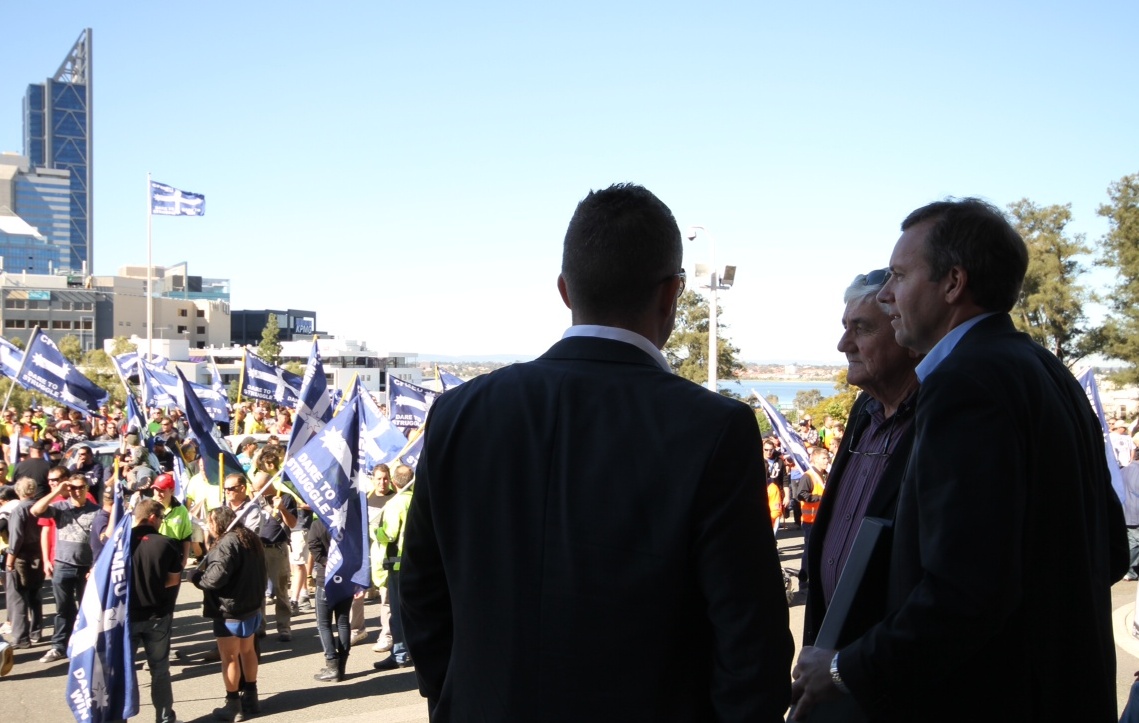
Hence, I went along to the local jobs rally at Parliament House yesterday armed with my camera and iPad, hoping to tweet the proceedings and add a couple of supportive images. It turns out listening, tweeting and trying to upload high quality images from a proper camera (i.e. not a smartphone) is a bit more difficult for a newbie independent commentator than I had envisaged – so kudos to these who manage to do it day in, day out.

Anyhow, the best this newbie could do was listen, occasionally tweet and upload some photos 4 or 5 minutes after they were taken. Here’s one of my favourites:


What I saw was a good couple of thousand passionate people, the vast majority of whom were either wearing or carrying some sort of union branding, lobbying the government in a fairly basic but effective way – with their bodies.


While it was an impressive turnout and certainly made a point, I couldn’t help but thinking how the impact on Government would have been much greater if there wasn’t so much overt Union branding.

Of course, for the CFMEU, MUA and their peers, this was an important opportunity to demonstrate that they still have the ability to get thousands of people to down tools and interrupt traffic – I get that and understand that’s why they would have encouraged the promotion of their respective brands. But unfortunately for those who are genuinely concerned about the issue of local content/jobs, the 99% saturation of Union t-shirts and banners make it very, very easy for any Liberal Government to just dismiss the rally as their known enemies doing their usual rabble-rousing.


I’m not suggesting any change in tactics for the Unions, but from the perspective of someone who loves to play political chess, I couldn’t help but wondering if the self-promotion was more valuable than landing a blow on the Government.

Having said that, there were two interesting things I heard guest speakers say that in retrospect might very well answer my own question:

  1. The declaration by one of the Union leaders that “we are finally working together again to get justice”, and
  2. The inclusion of a couple of Federal ALP Ministers on their hate list.


The first point was an interesting public confession that unions haven’t been working well together recently. Clever. Our Premier could learn a lot from the person behind that comment. Swallowing just a little bit of humble pie in front of those who have lost faith in you goes a long way to being forgiven.

But again, as a guy who has spent most of his adult life developing strategies for political change, I found the second point a little confusing. Why would the Unions choose to muddy the waters, or indeed, dilute their very pointy message to the State Liberal Government by throwing in some parts of the Federal ALP Government? Maybe adrenalin got the better of the speaker and it just slipped out or maybe Minister Ferguson is so universally stinky to the Union movement, they strategically dropped his name knowing it might damage the Federal ALP Government and blunt their WA message.

I don’t know which it is but thought it was one of the few interesting moments of the day.


PS. Perhaps something else our Premier could learn - it's important to support your supporters: a message clearly not lost on 2013 ALP candidates Reece Whitby and Bob Kucera who were there yesterday.

Monday, July 2, 2012

Reshuffle kerfuffle – Part 2: Troy Buswell

Other parts already published:

• Part 1: Timing

Other parts coming soon:

• Murray Cowper
• Michael Mischin
• Liza Harvey / Rob Johnson
• Staff fallout
• Cost to the State
• Other movements and their wider impact


I’ve said it before and I’ll say it again: Premier Barnett is a supreme thinker.

Take for example the way Troy Buswell found himself back in charge of the State’s purse strings last Thursday. From the outside, the Cabinet reshuffle the Premier announced last week looked messy, rushed even - and maybe it was -but the plan to give Mr Buswell the Treasury started a long time ago.

Given that Mr Barnett disclosed recently he had known Christian Porter was considering his move to the Federal sphere for “6 months or so”, this OpEd piece I wrote and never published in November 2011 shows the Premier was thinking of Troy way back then:

Something big shifted in Western Australian politics last week. Troy Buswell came back.
It was quietly reported that the Premier has asked Housing and Transport Minister Troy Buswell to re-join the EERC – the Economic and Expenditure Reform Committee. This group of senior Ministers meets regularly to scrutinise and evaluate proposals from their Ministerial colleagues. Basically, if someone wants to spend the State’s money, the responsible Minister has to make their case to the EERC.
And it’s not always a cordial affair. The meetings are often brutally open and frank in debate about the benefits of each proposal – economically and of higher priority to this group, politically. Ministers who don’t have the skills to sell their idea to their senior colleagues or bring forward a proposal that simply costs more than the EERC believes the State can afford, often leave empty handed.
Although the room also contains several advisers who play a significant part in the final decision, the meetings are typically chaired by the Treasurer who first asks the Minister to brief the meeting on the proposal. After the short introduction from the Minister or their Departmental Head, the Treasurer and his senior Cabinet colleagues ask clarifying questions. With the mix of personalities and intellect at the table ranging from cool, wise heads like Norman Moore, quiet contemplators such as John Day and ferociously barking attack dogs like Simon O’Brien and Brendan Grylls, chairing the meeting to deliver an outcome is no mean feat.
Which brings me to the big shift.
It is widely acknowledged that for a lawyer, Christian Porter is doing a great job of managing the State’s finances. Indeed, having sat through a number of fierce EERC meetings, Porter’s prosecutorial background equips him with an incredibly valuable skill for the Treasury portfolio – the ability to ask the right questions to quickly get to the crux of the issue.
So if the Treasurer is doing well, why would the Premier bring Buswell back to the EERC and risk it looking like a vote of no confidence in Christian Porter?
I propose two plausible reasons:
1. There will soon be a vacancy on EERC and the Premier is ensuring a hand-over
Given that the Premier confirmed Norman Moore expressed interest in the job of Agent General and then publicly defended the possibility of it happening, it is likely that the Premier is just ensuring EERC is fully staffed if Minister Moore departs in December.
The downside of this move is that Buswell’s presence on the EERC could cause tension between him and the real Treasurer – it’s always difficult to put aside anger and envy when you’re expected to work as part of a sled team that you used to lead.
2. December’s “minor” reshuffle will see more than just Troy Buswell back as Treasurer.
This makes sense on one level - Buswell is a standout in terms of intellect and political nous – exactly the kind of guy you would want defending the State’s economy in the lead up to the 2013 election. However, this is only sellable if Christian Porter is willing to say he isn’t enjoying being the Treasurer or moving on to something bigger and better. For those with ambition in politics, there’s only one job more coveted than that of Treasurer – you guessed it, the Premier.
As Premier, Colin Barnett is notorious for holding his cards very close to his chest so the public will know anything about his retirement plans until the day he enacts them. However, as unlikely as many say it is, it’s definitely plausible that he won’t be Premier at the next election.
Personally, the Premier turned 60 last year and after 21 years in the Parliament and 3 as Premier, he has a sizeable superannuation and good health that would allow him and his family to enjoy it. Professionally, he brought the Western Australian Liberal Party back from oblivion on the eve of the last election and has since stood strong and proud as the only Liberal Premier in more than his fair share of COAG meetings. Among an impressive list of his achievements in his 38 months as Premier, Colin Barnett brought the Queen to Perth, secured funding for the Stadium, started work on the foreshore redevelopment, sent more money to the bush than ever before and oversaw the beginning of construction of the Fiona Stanley Hospital.
Other than bringing water from the north, he has ticked a number of extraordinary boxes on any ordinary man’s bucket list – what else could he want in life? Perhaps a happy retirement on the porch of his Toodyay property reading about everyone dealing with what will be a difficult election in just over 12 month’s time.
Whatever the Premier’s rationale, the reinstatement of Troy Buswell to the EERC signals the beginning of a significant change to the Western Australian political landscape.
Watch this space.
(19/11/2011)
Colin Barnett hates the way the West Australian newspaper has given him the unofficial title of “Emperor” but the fact is he plots, plans and executes in a way that would have embarrassed many actual Emperors of the past.

Sunday, July 1, 2012

Reshuffle kerfuffle – Part 1: Timing

Other parts coming soon:

• Troy Buswell
• Murray Cowper
• Liza Harvey
• Michael Mischin
• Staff fallout
• Cost to the State


“Curious”, “erratic” and “suspicious” are all words you could use to describe it. Why did the Premier announce his Farnham-esque (“This is the last, last time, I promise”) Cabinet reshuffle on a Thursday while half the Parliament was still sitting?

In politics, Cabinet changes are big news. They are typically planned, with a full media strategy behind it to maximise the bang for buck and minimise any potential criticism. But this one wasn’t.

On the most obvious point, it’s far from usual practice and more than a little risky to announce Cabinet changes while Parliament is sitting and particularly only hours before the last “questions without notice” of this Parliamentary session. The Legislative Council is far less likely than their lower house colleagues to ‘go feral’ in that situation for sure, but nevertheless, the opposition was provided an unusual choice to really misbehave with minimal long term consequences. It turns out the ALP didn’t choose that path this time, but the point is the Premier took a gamble when he declared to the 500 Club fundraising breakfast that morning that he would be announcing a “wider than expected” reshuffle later in the morning.

And the question is why couldn’t he wait until 5pm after question time – or if he wanted the 6pm TV news stations, why not 9am Friday, just 24 hours later? Governments typically only make compromises by rushing out big stories like this to either distract the public (and media) away from some very bad news elsewhere or to circumvent some other unhelpful event, before it happens.

So what else happened on Thursday? There was the “no decision” of Environment Minister Bill Marmion regarding the release of the EPA’s report into James Price Point -but that was hardly something that was going to be overseen by environmentalists regardless. Then there was the Deputy Premier taking the media on a long-planned tour of one of the Government’s biggest claims to fame, the Fiona Stanley Hospital… but surely the Government would have hoped for otherwise “clear air” so nothing reduced the attention on such a good news story??? Other than that, I’ve struggled to find anything else that actually happened, state-wise.

So that leads me to suspect the rush was not to distract from something that actually happened, but to mitigate the chances of something bad eventuating. But it failed, like so many other attempts by this government to manipulate the media since late in 2008.

The threat they were trying to neutralise was of course, friendly fire.

I’m told before the Premier dumped former Police Minster Rob Johnson on Monday afternoon, he asked him to voluntarily resign. Mr Johnson refused and having shown his hand, the Premier was left with no choice but to make it, umm, un-voluntary. LoL

Anyway, there’s two important points that I wanted to make here:

  • To Mr Johnson’s great credit, even after that ugly interaction on Monday and learning that he was to be publicly dumped at some time soon, he attended several public media events AND flew to Melbourne for a meeting of Police Ministers, all the while maintaining a highly professional image.
Don’t underestimate the value of that - there’s been a lot of vitriolic “spit on your grave, good riddance” kind of comment out there since Thursday, but this man learned that he was soon to be publicly humiliated, held it together and got on with his job. Would you be willing or able to do that?
  • The Premier obviously knew from the moment Mr Johnson refused to resign, it was going to get ugly. He should have started this negotiation a long time ago, but I’ll explore that in a future part. However, given that he blew that opportunity and instead chose to thrust it on Mr Johnson on a random Monday afternoon, one might have thought he would also be brave enough to cop it on the chin (sorry about the pun, I’m in a good mood). Instead, he and his team of geniuses (as Minister Collier refers to them) decided to make the announcement while the outgoing Police Minister was on a plane flying across Australia. Good management? Nope. Honourable? I don’t think so. Another disastrous attempt at sneaky media strategy… yep.
And the rest, as they say, is history. After Mr Johnson landed and learned the Premier had done what he did – but only after and Mr Johnson deserves credit for that - he responded in the only way someone who had been treated so poorly could, with grave disappointment.

And given what I’ve just highlighted about our Premier and his advisers, that’s a disappointment we should all share with Mr Johnson today.

Thursday, June 28, 2012

Minister Collier has to go

Yesterday’s post explained why the Premier’s imminent pre-election reshuffle should include a replacement for Minister Liz Constable, but she’s not the only current Minister he should jettison forthwith.

Today, I’ll explain some of the reasons why the Premier should take the opportunity to also drop Minister Collier who is, as you will see below, a much greater liability to the Government than the Minister for Education.

Firstly, let’s clear the air about something. My last job in the Barnett Government was as Minister Collier’s Chief of Staff and despite what he said to Paul Murray during this interview our relationship did not end amicably. In fact, the termination of my contract was a total surprise to me – delivered via SMS by the Premier’s Chief of Staff while I was in New York on annual leave with my pregnant wife. I have had one conversation with the Minister since then, which I initiated, at 1am from my hotel room. During that 30 second call, I asked what I had done wrong and his response was, “It’s not like that, we are just very different people”.

While thankfully we are indeed very different people, I had spent the vast majority of my time in Minister Collier’s office working to arrest the high level of staff turnover and build efficiency through improved morale – and had quite some success. But to a genuine narcissist, efficient teams and stable human resources are of little value.

Some will attempt to paint that as nothing more than a vengeful spit from a disgruntled former employee – so be it. Regardless of how my detractors go about trying to play it down, there are many other examples of the Minister’s total disregard for others - and that is why he has to go. A Minister’s stock-in-trade is the strength of relationships he or she holds. They need people to trust them enough to offer the truth when asked and be open to conversations that end in accepting a compromise, or favour, for the Government - for want of a less corrupt-sounding word.

But Peter Collier is simply not capable of building those kind of relationships. His lack of willingness to discuss his issues with me face to face is one thing, but he’s also done some pretty ordinary things to others – like asking me to replace his longest serving staff member while that person was on compassionate leave trying to cope with a terrible family tragedy.

Some might question the public relevance but anyone who has ever held a management position will immediately understand the cost of staff turnover and poor morale - in pure tax-payer dollar terms - on top of the lost time and corporate knowledge that is now in the hands of someone else. In his office of 13, Minister Collier has seen around 40 staff come and go – a complete turnover of staff 3 times in just over 3 years. Just think about how that kind of change would impact on your workplace.

And it’s not just his office staff walking away.

Astonishingly, the Minister seems almost proud to take credit for what he rather insensitively calls “napalming” the upper levels of management of almost every agency he oversees. In fact, every single agency (Training and Workforce Development, Office of Energy, Department of Indigenous Affairs, Western Power, Synergy, Verve and Horizon) have lost its CEO on Minister Collier’s watch and many, many more highly experienced Board Members have taken their expertise elsewhere.

I am even aware of anonymous correspondence sent to the West Australian newspaper claiming that as a result of bullying by the Minister, a number of staff at the DTWD have suffered and taken ill. I am sad to say that if I hadn't intervened and stood in the middle, I’m certain this would have continued with devastating outcomes. The West hasn’t printed the correspondence because until now, no one would validate the claims – although it did prompt the Public Sector Commissioner to undertake an investigation into the way the Minister interacted with the Department. And that’s another occasion when I had to mediate because of a broken relationship. I recall discussions I had with Commissioner Mal Wauchope while the Minister was standing over my desk, insisting that the terms of the investigation be changed to an “examination” that included a specific reference to yet another senior (and superbly performing) Departmental officer he had in his sights at the time.

And there are many others he has “napalmed”.

Since I started writing my blog, I’ve been contacted by others who used to report to the Minister – some with harrowing stories of bullying and intimidation. The cost to Western Australian tax-payers in golden handshakes, reduced productivity and lost corporate knowledge is literally incalculable. But on top of that, in three short years he has turned so many friends of the government into enemies he has become a liability to the Barnett Government on that basis alone.

But his narcissistic arrogance and non-existent people skills have damaged the State in so many other ways – for example the embarrassing trip to the UK where he managed to offend, or at least mortify every one of the senior CEO’s that spent their time and money travelling with us to try to promote Western Australia as a working destination. There was the CEO who told me I needed to stop the Minister publicly denigrating the countries hosting our delegation, the several who asked me to stop him staring into his mobile phone whenever they wanted a quiet moment with him and of course the humiliating lunch meeting with senior officers of the Irish government when he declared that he “doesn’t eat lunch” and spent most of the meeting walking around outside the glass-walled room talking on his mobile phone, while the rest of us spoke on his behalf.

Notably, he still hasn’t provided a report to Parliament explaining the outcomes of the expensive and damaging two week jaunt.

Not only was that trip damaging, it was exhausting for all involved because he has an overwhelming need to have expert knowledge of everything he confronts. That manifests in three significant ways:
  • His diary secretary is explicitly instructed to accept a maximum of only two meetings in his office per day (but occasionally takes more when absolutely necessary),
  • He becomes highly anxious and unpleasant when he is surprised, and
  • His departments are put under enormous pressure by being forced to generate briefing notes for every trivial issue, including his own Cabinet submissions.
There’s a reason we don’t ever see the Minister on weekend news or at weekend events – there are no staff available to provide background briefings!

But the Minister’s failure to manage and optimise relationships and the impact this has had on the efficiency and effectiveness of his three critically important portfolios isn’t the main reason the Premier should replace him in next week’s reshuffle. It’s the Minister’s propensity to shirk all responsibility and mislead Parliament that are the real hanging offences.

Sadly, I haven’t yet had time to trawl through Hansard for specific examples but there are more than a few occasions the Minister has misled Parliament – here’s just two that I heard during question time on 15 May:
“As far as chiefs of staff are concerned, I was very sorry to see Colin and Blair go; they went on to other things. Darren moved on to something else” [Yes, a reluctant stay-at-home Dad]
“I have had only one change in media officers… she was fantastic but she wanted something a little quieter” [Outright lie, she was effectively dismissed]
I promise I’ll do that research very soon - if the Opposition doesn’t get to it first - but my baby needs to be fed and I can’t end without mentioning the reason the Minister was referred to as “slippery Pete” long before the Federal Speaker fiasco arose – and the serious image problem it causes for the Government.

While we have the Premier on the radio regularly offending people with his somewhat charming “tell-it-how-it-is” style of honesty and accountability, the Minister for Energy; Training and Workforce Development; Indigenous Affairs is working the room, taking credit for everything positive and busily blaming everyone around him for anything less than pleasant.

Again, there are many examples of this in Hansard, but I really liked this report in the West Australian last week when he did a classic Bart Simpson (“It wasn’t me”) and blamed his performance in the House on the poor Police Minister - Collier silenced over 'fake cop' scandal. Now, it just may be true that Minister Johnson had provided instructions to his Upper House colleague on how to deal with tricky questions, but it’s far from collegiate and a long way from in the best interests of the Government to escape scrutiny by blaming an already vulnerable Minister.

And that really exemplifies the core of why the Premier should dump this Minister now.

He isn’t a team player. He doesn’t understand the need to assist his colleagues. He does not have the best interests of anyone other than himself at heart. Quite simply, Peter Collier is not worthy of the Ministerial salary based solely on his lack of competency, let alone the wider damage his reckless self-obsession continues to cause the state of Western Australia.


Note: To answer any question about why I’ve decided to tell “my story” now – two things:
  1. There’s a chance the Premier will promote Peter Collier in this week's reshuffle and he needs to be fully aware - so he can be accountable - of the truth before he finalises his decision.
  2. Personally, I’m ready and quite anxious to move on. My professional reputation has suffered because many former friends and colleagues were left to make assumptions about the circumstances of my departure while others were actively misled. I need to set the record straight so I can set about rebuilding the bridges that were burnt from under me.

Wednesday, June 27, 2012

Minister Constable has to go

Honour is a rare commodity these days. And sadly, it appears to be one that some believe they can expediently trade when it suits them.

Take Minister Liz Constable, for example.

Regular QBF readers know that I value the intellect of Minister Constable and believe she has been a worthy contributor to our Parliament over her 21 year career. But quite simply, she now has to go.

There’s a couple of sound reasons for this.

Firstly, as I wrote in Too little too late - revolt is nigh, the Premier is under growing pressure from his constituents (no, not his subjects in Cottesloe-I’m talking about those who elect the Premier in the Party Room) to move her aside and give some actual Liberal Party members a chance to shine. It’s virtually a no-brainer that a retiring Independent will not and indeed, can not spruik Liberal Party education policies the way they need to be spruiked in the lead up to an election.

This is so obvious, frankly it’s embarrassing that the Premier let the situation arise, let alone condone it for so long. The only possible justification he can cling to in that regard is the fact that the Cabinet is so short of women, although that doesn’t say much for his confidence in competent Liberal women in the waiting, like Liza Harvey.

But internal Liberal Party issues aside, Minister Constable was elected in 1991 after a heavily factional Liberal pre-selection saw her resign from the party and run as an “Independent”. From her first words in Parliament, Dr Constable championed a few key causes:

1. More women in Parliament

2. Various Education issues

3. A more “open and accountable Government”

She hasn’t achieved the first one – although in fairness to her, it’s simply too big an issue for any single MP to fix. On point two, Dr Constable did the virtually impossible and attain the Education portfolio as an Independent, however her performance as Education Minister is not without its critics.

But let’s take a closer look at her third cause.

Dr Constable started her Parliamentary career by paying tribute to her predecessor in the seat of Floreat, Mr Andrew Mensaros as a man who set high standards. She continued by saying, “I hope that I will be regarded in the electorate and in this Parliament as he was - a person of substance, of principle, of excellent judgment and of compassion.”

And therein lies the rub for the Minister.

Being a person of principle isn’t really a flexible term. You either are, or… well, you wake up every morning, avoid looking in the mirror and recite, “it’s better to try to fix the system from the inside than hold on to rigid beliefs and have no influence”. Indeed, in order to keep her seat around the big table, I imagine many of Dr Constable’s days now start with murky self-affirmations just like that one.

It really is difficult to understand how she can reconcile continuing to take a Ministerial salary while being complicit in so many compromises of her career ideals. For example, the Member for Floreat as she was at the time, spoke of the need for Freedom of Information legislation in these terms:
“It should require all Government departments and agencies to publish details of their operations and the processes they use in making decisions. By granting citizens access to Government documents, freedom of information legislation aims to increase the citizens’ powers over the power of the State and it lessens the State’s claim to secrecy. As such, it is one of the instruments of accountability.”
Of course, we now have FOI legislation but rather than it empowering those hoping to better understand Government process, Minister Constable’s Government has form in using the process to do quite the opposite (eg. Secrecy claim over Govt staff payouts)

And of course there’s the lobbyist legislation that Dr Constable unsuccessfully tried to enact as an unsupported independent backbencher in 2003 and 2007 – which still hasn’t been passed despite her current Government committing to do so in its first 100 days, 1,290 days ago….

If you’re like me and try to take a pragmatic view of things, these examples of small compromise are probably a justifiable way to hold influence and contribute to addressing bigger issues.

However, as a person of principle who has vehemently and almost exclusively championed the need for more Government and lobbyist accountability for more than two decades, it’s nothing short of disgraceful to declare retirement, reduce your workload and expect to continue to be fed from the tax-payer’s teat for the next 255 days.

The Premier has no choice but to drop Dr Constable from Cabinet when he announces his pre-election Ministerial line-up early next week.

Wednesday, June 20, 2012

The negative opposition fallacy

I was involved in a Twitter conversation last evening that was started with this Tweet by @sarahscustard:
“This campaign bugs me. Do you really have to campaign on negativity and cheap statements? :( #wapol “
I’m very sure it was a genuine question and not a strategic attack from an anti-Labor campaigner. Regardless, it led to a good, robust conversation that attracted input from the ALP State Secretary, two Members of the Upper House and a couple of others including social commentator and aspiring politician, @troutish and myself (@_darren_brown_).

It was worthy and while I won’t go on about the reluctance of this Government to use social media more proactively, the discussion did confirm two things for me:

  1. There’s a bunch of people out there who are interested in our political system but at risk of becoming disillusioned because no one takes the time to offer a counter argument to the cynical views developed by reading newspaper headlines and watching 7 second grabs on TV, and
  2. Social media, like Twitter, provides a massive opportunity for someone to offer that alternative view and hopefully engage more people in our political system.
I’ve always been an advocate for greater engagement and involvement , but until today hadn’t seen that it’s probably something I could be doing more to facilitate, for the betterment of all – and hopefully to prove that I have yet another skill worthy of payment! :-)

So let’s address the question raised earlier today.

Why are Oppositions so negative?

Firstly if the title isn’t obvious enough, they aren’t in control of the State’s policy agenda. That is, their job is to offer an alternative to the government, or to oppose. That doesn’t mean Oppositions blindly oppose everything just because they’re not holding the reigns. In fairness, there is actually a lot that happens in Parliament where all Parties say their piece, then agree to compromise a bit for the sake of practicality and productivity – during the committee stages of new Bills is a good example of where that happens a lot.

And because of that, it’s sometimes very hard for the media to report the happenings of Parliament in a way that will even be heard, let alone interesting to the majority. As an example, when I worked in the office of a Leader of the Opposition, I was constantly frustrated when news outlets would report the outcome of our Parliamentary tactics as, “The State Opposition failed to suspend standing orders today” when it should have been, “The Government used its majority to deny the Opposition’s motion to suspend standing orders today” - but again, most of the voting public would rather watch Bear Grylls sucking the gizzards out of a live snake than follow through on a headline that simply confirms an expected outcome, so in retrospect who can blame a journo for trying to “sex-up” a daily summary of Parliament a little?

So that leads to most of the voting public only ever hearing about the disagreements in Parliament, and only when they are passionate and animated enough to compete with Mr Grylls drinking his own urine – Bear, not Brendon that is. And from that, it’s really no wonder many believe that all Parliamentarians carry on like pork-chops every day and the Opposition (regardless of political colour) never offers anything positive to the debate, just criticism.

But it’s more than just perception. It’s a huge gamble for any Opposition Party to release any specific policy too far out from an election, particularly if it’s innovative or if it involves significant expenditure. And when I say too far out from an election, I mean pretty much anytime before the caretaker convention kicks in.

While this is frustrating for the public, it is really quite easy to understand.

In comparison to the Government, Opposition Parties really do have very limited resources. The Leader has 10 or so staff and that’s it. Everyone else is multi-tasking – and working only with publicly available data. The Government on the other hand, has access to privileged information and thousands of departmental staff available to analyse policy ideas both in isolation but importantly also how any change in direction would impact across the rest of the government, with the benefit of knowing what else is on the agenda.

This means an almost impossible no-win situation for any Opposition with big ideas. If they release an innovative policy before the caretaker period, the Government will employ its significant resources to study the opposition document and either adopt it and implement it if it’s a good idea or pick it to pieces and use its large microphone to explain every single risk or flaw, thus rendering the policy more of a liability than an asset to the opposition come election time.

And there’s one more legitimate reason for Opposition Parties to keep their big policies under wraps until close to the election – money. There’s a few variables that determine how much both the Opposition and Government can spend in election commitments.

Firstly, there’s the amount of money the State can squeeze from the Federal Government in terms of GST reimbursement. The Premier and former Treasurer made a lot of this lately and WA’s share is planned to fall significantly however, in terms of making election promises, at least this figure is known well in advance i.e. it’s something everyone can budget for.

The next big income source is one that neither the Government nor Opposition can accurately predict, although the Government has information that should always give them a better idea – Royalties. Given that the State’s income is increasingly bolstered by the sale of commodities, fluctuations in international demand and the value of the Australian dollar means no-one really knows precisely how much cash the State will get until the ships have unloaded their ore at their destination. Having said that, Governments will sometimes use very conservative assumptions as to the value of the Dollar and likely levels of export so they aren’t caught short – and that means they often have a larger than predicted surplus to play with every May.

The last one is the killer for Oppositions. The fact is, Governments ALWAYS try to underestimate the level of surplus in pre-election budgets so they can announce a surprise windfall (and associated new spending and projects) just in time with the election. Lots of games get played with the budget papers to hide or underestimate money in pre-election budgets and the one being debated in Parliament right now is no different.

The problem for the Opposition is they have to base their election promises on what is visible in the budget papers – if you believe you only have one dollar, it’s irresponsible to promise to spend two. However, the Government knows where the extra money is buried and exactly when it’s coming, so expect a new school, tax cut or some other sweet promise from the incumbent Government that the Opposition will never be able to match, simply because they didn’t know there was enough money to do it.

So really, Opposition is a pretty crappy game until a month or two before an election when the Government shows its hand and you get to see what they’ve been hiding. Until then, it’s almost always unwise for Opposition Parties to release detailed policy commitments because it’s simply too dangerous.

Having said that, it should be noted that New Labor, under Mark McGowan appear to have made the conscious decision to start rolling out election promises early. Given what we’ve discussed above, that’s remarkably courageous or just plain stupid, but I guess only time will tell.

Tuesday, June 19, 2012

Lord of the flies

Imagine you’re an honest, hard working kid who has been beaten up by the grumpy school captain for three years. Pretend that when you first met him, you admired his knowledge and thought you and he could be friends, but after trying for several years to get into his exclusive lunch circle, the most attention you have ever had from him is his wrath.

Then one day a kid who doesn’t mind copping a bit of his flak comes along and openly challenges him. Then a few others join in and soon it looks like he is about to fall… where do you think human nature would lead you?

As a keen observer of what makes us tick, I predict all those who have been ignored or beaten by the head bully would join together and assist the fall.

Enter Premier Colin Barnett, his “remarkable stable” Cabinet and the throng of eager but ignored backbenchers watching the chink in his armour widening…

I’ve said it before, but just in case I was too verbose – in politics, it’s easier to maintain the support of your colleagues if they like you. And it’s probable that if you irritate too many people, one day when you develop a little hole in your shiny suit, they will, at best sit back and let you fall or worse, join in the fracas and actively help bring you down.

So here we are.

The Premier has been Mr Grumpy Pants for 3 years, shown no faith in his wider team, irritated a lot of people along the way and somehow still thought he had enough friends to impose a candidate for Churchlands on the lay Party.

Something about chickens, roosting…

And his response?
"I think Kate Lamont was clearly the outstanding candidate in that field, some good candidates, but Kate Lamont should have been selected... The people of Churchlands, it’s the adjoining electorate to mine. They are basically Liberal voters. And they have an expectation that the Liberal Party will deliver the highest quality candidate they can into that electorate. And I don’t know that we’ve done that”
Instead of apologising to the candidate to whom he gave false hope and standing up to the outgoing Member, he attacks everyone else. He’s a knowledgeable man, but doesn’t seem to predict human behaviour very well.

Now back to the school yard.

Isn’t it now almost inevitable that all those kids he snubbed will see the chink in his armour and either watch while he falls, or actively contribute to his downfall?

PS. I was wrong in predicting which candidate would get up (because the western suburbs clique isn't as strong as they thought they were), but if you have time re-read the bottom of this article about why the Premier has sprayed the lay-party today: The unholy fight for Churchlands (part 2)

Friday, June 15, 2012

Response to reader "Wizman" comment

I normally post replies to comments as a comment, but I thought this one deserved a post of it's own.
In response to Even children have depth perception, wizman commented at June 15, 2012 9:54 AM:
i caught you on 720ABC in the afternoon talking about liz constable and her replacement (you and peter kennedy would be a great state politics double act). anyway, with christian porter leaving, will a backbencher get 9 months to show some promise or not? when liz constable goes and assuming barnett wins again at the state election, does the "new member" who may or may not be delivered by parachute get a free ride into cabinet, or again does barnett trust a backbencher? if he continually overlooks the elected members doesn't this just reinforce the opinion that there is no talent, or is it just barnett's "incompetence as leader" at work again?
My response:

Hi Wizman.

Firstly, thanks. I admire PK and would love to work with him (WABN and ABC: Hint! Hint!)

I honestly hope Mr Barnett takes a bit of a calculated gamble by throwing a couple of backbenchers in the deep end, but I really don’t think he will. He reinforced that yesterday in Parliament in an answer to a question without notice – he made way too much of the fact that he has had a “stable” cabinet, effectively making yet another rod for his back. He is a very conservative man who prioritises stability in the public sector.

Unfortunately, that causes two big problems:
  1. Retiring Ministers are very problematic at elections. Norman Moore will be in Parliament for a few months after the election (because the LC doesn’t change until May 2013), so that one is not a drama. However, how on earth is the Government going to articulate its Education election promises when their spokesperson can’t speak for the party (because she’s independent) or the future (because she won’t be part of it)? I’m guessing that’s another role the Premier will probably take on in the caretaker period before the election.
  2. The other, which I think is the biggest problem and one that Mr Barnett is not fully cognisant of is the huge morale problem brewing in the back bench. Imagine being a 2nd or 3rd term Liberal backbencher who has played all the games and done as you were told for the last 8 or 12 years and hearing the Premier cite Independent and National MP’s as evidence of his available talent. Good leaders are inclusive and lay out a growth path for their ambitious subordinates – and Colin fails to do that over and over again. He needs to remember what happened to Natasha Stott-Despoja and Kevin Rudd – both very popular with the public, but rolled by their immediate constituents – their subordinates – because they weren’t making them feel valuable.

Colin’s reluctance to take a punt on anyone new is not evidence of the depth of the talent pool. It is, however absolute evidence of one of Colin’s worst qualities, which will be his downfall in spite of his many good ones.

Wednesday, June 13, 2012

Even children have depth perception

My father is good man. He has always been kind and loving and also knows a thing or two about human nature. And he used that understanding to teach me some valuable lessons. As a child, I remember sharing dad’s warm and secure canoe in the middle of a serene section of the Collie River during a camping trip in the area. My memory is that at the time, I had swimming skills but wasn’t a particularly confident swimmer - so guess what he did? Yep, unannounced he rolled the canoe onto its side and tumbled us both into the icy cold river. Within seconds I was doggy paddling strongly toward the muddy banks and from that day on, never again doubted my ability to swim.

It might seem a bit brutal, but it worked. Just like mother birds push their chicks out of the nest and horses nudge their foals onto their feet at birth, there really is something to the old theory of sink or swim.

But it seems much of today’s public don’t agree or at least don’t have the generosity to acknowledge that they do. Sadly, in the hours following yesterday’s resignation of WA’s Attorney General and Treasurer, I heard on talkback and read on news websites the same old tired rhetoric about the depth of talent in our parliamentary backbenches.

Rik Oshea’s post on the ABC’s Facebook page was indicative of many:
“My view? Staggering indifference. Had he stayed we'd still have a serious lack of depth problem. John Tonkin & maybe Sir Charles Court were probably our last real statesmen, not sure we have any great legislators at present.”
This is sad partly because it shows the level of cynicism the public maintain toward our Parliament but mostly because it is just so ill-informed.

The truth is it is very, very hard for anyone other than the Premier, Leader of the Opposition and Ministers of controversial portfolios (like Police) to get enough public airtime to be recognisable, let alone fairly judged on their abilities. Thirty minute press conferences are condensed down to a 7 or 8 second “grab” on TV news, newspaper column space has to compete with ever encroaching advertising to pay their bills and there is simply no way talkback radio can give any time to anyone other than the Premier and his direct nemesis.

The ugliest part of this truth is the vast majority of us would prefer to see a pretty blonde girl talking about the weather than watch an unscripted 3 minute address from any one of our political representatives. And because of that, it’s deeply unfair and often wildly inaccurate when people who have never met or even heard more than a 7 second grab from any of our Members of Parliament to judge their talent or lack of.

I know I won’t change many minds with this post, but I think it’s a very important point to make.
Journalists and their editors are often blamed for not providing the public with more opportunities to get to know their representatives in their own words - without truncation. But the fact is, like politicians, one way or another journalists get paid by the public and would therefore alter their content accordingly if there was a stronger demand for more open access to our MP’s.

That perpetual conundrum aside, of greatest disappointment to me as someone who knows there are many competent, hard working people who are invisible only because they are confined to the shadows of their respective Leaders, is that rare opportunities to shine a light on them aren’t being embraced.

I’ve made it very clear before that I respect Colin Barnett for his intellect and historical knowledge of all things politics, but his incompetence as a leader never ceases to amaze me. Yesterday, when a lazy journalist rolled out the cliché that he doesn’t have much choice in choosing a replacement for Christian Porter, he cited Ministers Constable, Hames and Buswell as evidence to the contrary. It is telling and deeply disappointing that Mr Barnett’s first and immediate reaction wasn’t to jump on the chance to talk about how he has too many competent backbenchers to choose from.

As I said above, there are a number of others in the shadows – on both sides - waiting patiently for their time to shine. Like my good old Dad, I have faith that many of them will quickly become strong swimmers if they are ever thrown in the deep end.

With regard to the Premier’s next move, I would love to see him undertake a bold reshuffle that sees 3 or even 4 backbenchers thrown in, but unfortunately I think his aversion to risk will see only one new face and a bit of a rearrangement of the deck chairs.

I hope some day soon our political leaders take the time to realise that blaming the media for missing opportunities is a moot point when so many massive ones float past them, the people we pay to set the agenda, apparently without even being noticed.

Monday, May 28, 2012

Max and the other cut snakes

I’ve thought a lot about how I think over the years. One thing I’ve worked out about what happens in the big old round thing on the top of my shoulders is that in the most part, words get translated into pictures before I can process them.

So when I think of Parliament my heart sinks, because the image that follows is a fuzzy big grey blob.

It’s not quite as boring as that. It moves around, almost spinning on its axis – but it’s not that controlled either. Every now and then I see little bursts of colour, but they are either sucked into the centre of the blob and assimilated or wildly spun out to the edge and discarded…

Which brings me to the way Nationals’ stalwart Max Trenordan was treated by his party over the weekend - spun to the edge and discarded.

I’ve known Mr Trenordan for a long time and it’s been an honour.

I remember one particular occasion when he invited me to dinner at his house in Northam with the then Deputy Prime Minister Tim Fischer. It was nothing like what I expected. There were no silver spoons, no real formalities and not even very much in the way of politics. My memory of the evening includes images of a fire in a 44 gallon drum, lots of laughter, a few cowboy hats and a dog that had a rather unhealthy interest in my leg. It was honest, friendly, down to earth and very… Max.

The truth is Mr Trenordan has been one of those rare colourful bursts in Parliament - and he’s paid his dues by serving both his electorate and Party with vigour for 26 years.

Now, I’m not suggesting a statue for Max. He’s done a job and he’s been paid for it. Everyone knows that particular job comes with some perks and many, many risks - one of which is the very real possibility of losing it at least once every 4 years. And regardless of the vocation, there’s probably some wisdom in prompting change, or “renewal”, after a quarter of a century. So with all that in mind, it’s not the discolouration of the National Party I’m lamenting. I accept that the public’s growing hunger for the salacious means all political parties will probably respond with candidates who are less colourful and more likely to blend into the big grey blob that is our current Parliament.

My issue is the lack of courage, respect and courtesy inherent in the way Max was dumped. Frankly, he deserved better. He deserved the chance to step aside on his own terms, with a little bit of time to plan a somewhat more graceful departure. If it was inevitable (and sometimes in politics, that’s just the way it is), his retirement as a National Party Member should have been negotiated, not thrust upon him.

But some heartless individuals might propose, “C'est la vie,” “Live by the sword, die by the sword” or even “If you can’t stand the heat, get out of the kitchen” as justifications for this kind of bastardry.  And I might even get a vitriolic email from someone who claims to be a political genius suggesting that this is merely an example of “beautiful Machiavelli” in practice...

I say the clichés are fine, from afar - and just because there’s a fancy Italian name for stabbing people in the back doesn’t mean it’s smart politics. Indeed, it’s probably the opposite. There is really only one absolute rule in modern Australian politics: to succeed, you need more friends than enemies on election day, and it really does help if they stay friends for longer than a day.

This stuff – knifing loyal servants without doing enough damage to ensure they don’t fight back - is possibly the most foolish political manoeuvre possible. In vernacular perhaps more familiar to traditional Nationals’ voters, don’t just cut a snake. Either coax it away, leave it alone or behead it.

But injuring people - foolishly turning friends into enemies - isn’t the exclusive domain of the National Party.

In July 2010, around five months before the second of the Premier’s ‘John Farnham’ (the last one, I promise) reshuffles, Mr Barnett’s Chief of Staff (CoS) asked me to stay back after a weekly joint CoS meeting.  In an alcove of the 24th floor meeting room, he quietly and delicately asked me if I thought my Minister at the time, the Hon Graham Jacobs, would be “amenable” to a discussion about his future as a Minister.

Knowing Mr Jacobs was, at that time, a very loyal supporter of the Premier, I responded, “Yes, however this is not a discussion you and I should be having. Graham is a very strong supporter of the Premier. If Colin takes the time to speak with Graham one on one, I’m sure they would be able to plan a win-win outcome.”

Sadly, the very next discussion regarding that occurred was when the Premier walked up the hallway to the Minister’s office on that day in December 2010 when the very decent, very loyal Minister Jacobs learnt that his Ministerial career would come to an end in a few days time. In retrospect, the Premier’s arrogance was kind of funny – I received a phone call from his diary secretary who told me “the Premier is on his way up to see your Minister.” The funny thing is that the Minister was out of the office at an official event and was going to be for some time. Apparently the Premier’s car was promptly turned around and the ugly 5 minute meeting happened later in that day, when the always busy Minister Jacobs could fit it in.

So there you have it.

We are soon to inherit a new generation of political hopefuls who think this kind of disrepect is not only acceptable, but the norm.

And Graham Jacobs and Max Trenordan share a lot more than just being honourable, loyal conservatives. They also share some of the colour we desperately need in our ever-greying Parliament and because their respective Parties didn’t have the political wisdom to treat them with the respect they deserve, they both have at least 9 months to brighten the walls of Parliament with the many tones of blue blood.

Friday, May 25, 2012

The trouble with lobbyists…

The trouble with lobbyists is that the Government is too afraid to admit it needs them and the community benefits greatly from their expertise and work.

The controversy this week about the $25,000 per annum Liberal “Leaders Forum” highlighted a couple of really disappointing things;
  • The Premier is still so afraid of public perception issues that when he had an opportunity to educate everybody about the truth of what happens in politics, he ran away at top speed; and
  • Neither the media nor wider public understand just how valuable lobbyists are to everyday Australians.
This is a hard post to pen because I’m not sure my non-staff readers will understand, let alone support it. Right now, I guess I’m feeling what the Premier felt just before he denied those who pay $25,000 a year to be part of the somewhat secretive “Leaders Forum” do so to allow them to directly lobby him and his colleagues.

And I really empathise.

It can’t be easy for Colin Barnett. While he sulked on the backbench during most of the last government, he saw those doing the hard yards bring down a number of ALP Ministers by systematically attaching them to the stink of corruption. In some cases, former Ministers were ultimately cleared of any corrupt behaviour but what Mr Barnett and the rest of us in the Office of the Leader of the Opposition knew was that perception is sometimes just as powerful as evidence.

In politics, casting doubt can be enough to turn a Minister’s shiny armour coating into a rusty old death trap overnight.

But even so, I’m disappointed in Colin. I really thought he would oversee an accountable executive and be strong enough to push back against our society’s growing desire to prosecute on perception rather than fact. But it appears even someone as wise and principled as he hasn’t been able to reverse the public’s self-fulfilling prophecy of political incompetence, fuelled by our constant over-scrutiny of our political system and the people who interact with it.

Don’t get me wrong, I’m not advocating anything less that proper accountability, but the feigned horror many expressed when talking about the Liberal Leader’s forum this week was simply too much for me to stomach. The thing that really irked me was the way Mr Barnett backed away from the truth and missed a prime opportunity to educate us all about the genuine value of lobbying.

The simple fact is that without lobbyists, we would all be bound up in unworkable legislation and other public policy, written and enacted by people who have absolutely no understanding of the real-world impact of their decisions.

As an example of this, one of my first jobs in a political office was as a researcher. In that role, I helped the man I worked for prepare responses to parliamentary debates and speeches. I distinctly recall this occasion because of the utter fear I felt when the Member came to me and asked me to prepare some notes for his contribution to writing a piece of legislation regarding the services provided by gynaecologists in Western Australia – that’s right, a 30-something, childless, unmarried man writing notes for the male member of the Opposition who would next week be leading his side’s debate on, umm, gynaecologists. Fortunately, the Member I worked for at the time is a good man and not egocentric or foolish enough to believe he could just stand up and “wing it” off the cuff.

So how valuable do you think the contribution of the Opposition would have been to that debate if it wasn’t for my ability to pick up the phone and talk to some representatives of both the doctors and patients of the people who would have had to work within the resulting legislation?

And as a Ministerial Chief of Staff, I have sat through no end of meetings with individuals who simply have no understanding of the process of government. Some of these people had great ideas but the only reason they were able to make a meaningful contribution was because they were accompanied by someone who understood both sides of fence – you guessed it, a lobbyist.

Indeed lobbyists provide an incredibly valuable service to the community.

Without them, Ministers who were Bus Drivers and School Teachers in their former lives would have no choice but to take the word of their departmental staff every time on every decision – sometimes regarding billions of dollars of public expenditure or the direction of legislation that impacts on the lives of hundreds of thousands of every day people.

And while I am a staunch defender of the professionalism of the majority of our public service, it is not too unkind to point out that sometimes they simply aren’t aware of the practical implications of their policy recommendations. That’s a for no other reason than the fact that they are not necessarily at the coalface every day – unlike those who represent individuals and industry, such as lobbyists and CEO’s of companies.

So why didn’t Colin just say that the Leader’s Forum provides a unique opportunity to hear the truth directly from people at the coalface about the direction the Government is taking? It’s obviously the perception that the money buys that guaranteed access – and I’m not going to insult QBF readers by suggesting it doesn’t. Of course it does.

Let’s stop the crap.

It’s messy, it smells a bit and it’s easy to pretend we didn’t know this happens while jumping up and down about how the wealthy get special favours, but the hard facts are that every cent is publicly declared as required by OUR law and both sides of politics do exactly the same thing.

And as unpopular as it might make me, I for one have the courage to publicly say thank goodness our political parties are being well funded (as long as it’s declared) and thank goodness business leaders are speaking directly to our political leaders.

But perhaps the ugliest truth of all is that even if the Western Australian public were given a chance to talk to the Premier about policy, most wouldn’t know where to start and many others would prefer to stay at home drinking their beer and watching football on their plasma TV’s than genuinely try to make our State a better place.

Thursday, May 17, 2012

The 3 C’s of Perth’s power problem (3xC+1=3P)

(I know you think I’ll say Colin, Collier and Cock-ups but since I can’t seem to get off this topic, I wanted to prove that I’m really not that predictable! Read on for 3 C’s I’m talking about. :-))

So here it is. None of us want higher power bills. And regardless of what anyone may think, not even the energy providers want it to rise arbitrarily. They want people to feel relaxed about turning their plasma TV's on and certainly don't like to see daily news stories that speak of their product as if it is some sort of flesh eating bacteria. 

But why is the Western Australian public so angry about the price of their utilities?

The answer is sadly about message management - or to use more popular vernacular, spin. That might sound like an opening line to attack the current government, but in this case I’m suggesting the Government should have given us more.

Settle down! I know that doesn’t sound sensible. Just bear with me…

The harsh reality is the cost of electricity production, transmission and safety has dramatically increased over the last decade or so. The south-west of WA (SWIS) is covered by a huge, and consequently somewhat inefficient, network. The rest of the state is powered by a disparate mix of even less efficient small isolated systems, often located in very remote (and therefore expensive to service) areas. The power in these isolated systems generally costs a lot more to produce than that in the consolidated SWIS but because all governments support the idea that country people shouldn't be punished for living in regional WA, city power users subsidise these tariffs so everyone pays the same for power, regardless of where they live.

In short, WA really does have some very unique challenges and they unequivocally add to the pure cost of power. That’s not the Government’s fault.

And the Barnett Government has been desperately trying to get that message out, but because they only started in earnest up after people got huge increases to their power bills, many voters thought it was just cynical spin. When people think governments say something only to justify their bad decisions, they get angry and stop listening: "Sweetheart, I know what you think you saw, but I only touched her there because I was giving her CPR..." - sometimes, even if there's a good explanation, it's just too late to be heard.

So, the Government probably should have had little or no tariff increases in 2009 and spent A LOT of time in their first year educating the public about the need to increase tariffs in future years, perhaps even offering big incentives for people to upgrade their inefficient appliances and change wasteful habits in advance of the inevitable price hikes. They probably should have also tried to explain that the biggest power users are in the most wealthy suburbs and that means honest tax-paying mums and dads are actually subsidising millionaires to run 5 plasma TV’s and a filter for a lagoon in the backyard of their 12 bed Dalkeith mansions.

That’s a simple fact and while it would have irritated the millionaires, it could have been a pretty easy sell to most mums and dads – if it came before the increases. Indeed, if they had done all that in 2009, the Barnett Government MIGHT have been able to win the public over in their current Keating-esque “increases the public needed to have” campaign.

But of course hindsight is a wonderful thing and to be fair, the Barnett Government's first budget was framed in very uncertain global financial times. They were rightfully nervous about future income, had to start saving for some big election promises (eg Stadium, Waterfront, permanent payroll tax cuts – oops, never mind) and had to try to do all that while handing over great wads of cash to their new minority “partners” via the Royalties for Regions scheme.

So another self-question that would make KRudd proud: Given we are where we are right now, what can the government do to reduce pressure on electricity tariffs?

Ah, the first C - Control. And to be a bit more specific – genuinely putting one person in control and making them fully accountable for it.

This is management 101 stuff – when an individual is given genuine responsibility and autonomy for something, they are far more likely to deliver results - or at least be the only person to performance manage (or napalm if you’re Minister Collier) when things go wrong. The theory is sound, easy and really self-explanatory.

But alas, this simple management practise just doesn’t seem achievable within the “highest levels of government” (Sorry Peter, you cracked me up when you said that on 6PR the other day). We already know the Minister for Energy and Premier barely speak, let alone genuinely collaborate on anything in the energy portfolio.

I really don’t know how to fix that. They simply hate each other and the wounds run deep. Peter is still grumpy because he didn’t get the education portfolio almost 4 years ago and to rub salt in that wound, the Premier didn’t stay very long at his 50th birthday party. Colin, well Colin is generally grumpy with most people but he especially despises unintelligent, political forg.. err, power-brokers.

Anyhow, that relationship is not going to get any better, but beside those two pushing and pulling the levers of control to spite each other, the situation has been made worse with the emergence of a third dysfunctional relationship – the government’s own “independent” economic regulator, the ERA.

For example, if all three were on the same page, today’s budget would have included a 6% or $100 a year reduction in people’s power bills by simply following this recommendation from their own expert authority:
“The subsidy to Horizon Power is not a cost that is associated with generating, distributing or retailing electricity in the South West. It is a cost associated with a Government policy decision. Just as the subsidy for Water Corporation’s regional customers is not paid for by Perth customers, neither should the subsidy for regional electricity consumers be paid for by Synergy’s customers. The subsidy should be provided by a Community Service Obligation (CSO), which is funded out of general taxation revenue, as is the case with water customers. The TEC (Tariff Equalisation Contribution) currently accounts for approximately $95 (or 6 per cent) of a residential consumer’s annual electricity bill in 2011/12.” Page IX ERA Inquiry into the Efficiency of Synergy’s Costs and Electricity Tariffs: Draft Report 4 April 2012
The Minister needs to take control and the full responsibility for Energy. I suspect we would see him drop that ball pretty quickly, but to be fair on him, he has been trying to juggle it with 2 other pairs of hands in the mix.

Next is Creativity (in competition).

We’ve heard for three and a half solid years now that competition would reduce power costs. The boffins convinced me at least that if a consumer has a choice of supplier, they will probably buy from the cheapest one. That in turn will force all the competing suppliers in that industry to find ways to bring down their costs so they can remain competitive and perhaps even offer their services cheaper – or simply go out of business.

This would have the dual benefit for the Government of bringing down electricity tariffs and being consistent with the core philosophy of the Liberal Party. However, the problem is that the current retail price of electricity is less than it costs to sell it and it is simply not financially viable for private providers to try to compete with the State-owned utilities. So the Government has been using the blunt instrument of increasing retail prices so it becomes attractive for others to compete which would presumably, um, bring prices down… yeah.

But us plebs who would be assisted by this magical increase-to-get-a-decrease policy have revolted mid way through the government’s grand plan and the poor Minister hasn’t got a clue as to how to calm everybody down. So the best they have come up with is to stop pursuing cost reflectivity, leaving us with higher costs and no extra competition. Bugger!

But what if we had a Minister who spent time trying to find new ways of creating competition?

Here’s an idea: given that the government already subsidises the state-owned providers of electricity, why not just offer that same level of subsidy to private providers on a per kilowatt hour basis? The ERA knows how much it should cost an “efficient” operation to supply power and the government sets the retail tariff. All it needs to do is offer the difference between the ERA’s efficient cost and the current tariff to all and sundry. If a private company can do it cheaper, they would get to keep the difference. Synergy et al would soon become more efficient to try to regain the government subsidy and eventually the cost would be driven down, lowering the “cost reflective” price and eventually competition would thrive without government assistance.

The last C is perhaps what we need the most in our Energy portfolio – Courage.

In politics, you can win votes with policies that make life easier for your constituents and sometimes you can even win people’s support by being genuinely courageous – even if it makes life a little harder.

What doesn’t win support is telling people they have to suffer until you get to a certain point then stopping before you get there.  To the average punter that just feels like you’ve caused them all sorts of pain with absolutely no gain. At that point, they are not only hurting but can’t even respect you for making the hard decisions and sticking to your guns.

This is something else I raised at a Chiefs of Staff meeting before last year’s budget. I explicitly asked the Premier’s Chief of Staff how we would explain our apparent reversal of policy when we decided to slow our pursuit for “cost reflectivity”. He looked bewildered, as though I was speaking in another language and simply said, “I don’t think that will be a problem”.

It turns out, it is a problem. It’s a big one.

Higher prices piss people off for sure. But cowardly retreat in the face of a fight and random policy reversals make people question your competency. And in the case of energy, that’s a fourth “C” the Minister falls desperately short of.

Wednesday, May 16, 2012

The unholy fight for Churchlands (part 2)

I wanted to write about something totally different today to prove that I'm more than just a one trick pony.

After all, I was in the room when Troy sniffed the chair, saw and heard all sorts of things that happened near the photocopier in the leader of the opposition’s office, saw a few good liberal women get destroyed, and was present when a number of very honourable people like Graham Jacobs were… well, let's just leave it at that.

But unfortunately, all that will have to wait because sadly I have to again write a post that relates to Peter Collier.

Just a side note: Paul Murray was quite correct in this amazing interview with the Minister – I am looking for work. If you are interested in some bold strategic advice, no-bull political commentary or even a guest writer or panel member who will entertain your audience with politically incorrect anecdotes and insights, I'm just a click away! (thank goodness we are getting those prostitution laws soon huh?) :-)

Anyhow, back to the glossy Peter Collier.

For those who asked me why I said the unholy battle for Churchlands would re-open old, very tender Liberal wounds.... Whulla! I give you this news article from the ABC yesterday.

That article doesn’t explain the whole background, but this Stateline transcript from 2005 certainly does.

After reading those articles, you might be inclined to think the allegations resurfaced because ALP Member Martin Whitely has a long memory.... nope! It was front of mind for him yesterday because the now-energy efficient halls of parliament (they auctioned the old power guzzler chandeliers off yesterday - presumably because the Speaker couldn’t afford his power bills like the rest of us) are abuzz with this old, very tender Liberal wound. We are of course talking about this because of the unholy fight for Churchlands.

After I published the unholy fight for Churchlands (part 1), I received an email from a very nice Liberal member who honestly couldn’t understand why I thought the pre-selection battle would get ugly. This person said they were at the State Council meeting and it was all very cordial and pleasant.
The emailer is of course correct but obviously isn’t much of a chess player. Chess, like any game of influence, requires a player to not only see the current state of play, but think about how all the pieces might look in the future.

The fun bit for those of us who are watching from the sidelines is that both Premier Barnett and Peter Collier are pretty good at this.

Here are some important facts to consider when thinking about what will happen next in this pre-selection.

1. Minister Collier holds the majority of the votes in the Curtin division – certainly enough to play a major role in deciding who will win a usual pre-selection process in Churchlands.

2. He supported his new Chief of Staff, and fairly well regarded Young Liberal Richard Wilson, who nominated in the usual way.

3. After pre-selctions closed, the Premier (and his senior media adviser Dixie Marshall) “suggested” to outspoken business-woman Kate Lamont that she put her hand up for a seat.

4. After learning of the Premier’s desire to install Ms Lamont, Collier clique member Senator Mathias Cormann moved a motion at State Council to re-open nominations to facilitate her nomination.

5. Ms Lamont nominated for Churchlands.

6. Peter Collier’s Chief of Staff withdrew his nomination.

7. From out of nowhere, long-serving Party member Jane Timmermanis took the opportunity to also nominate.

To piece all that together is pretty easy – while Peter Collier is definitely a chess player, he is constantly frustrated by others because his moves are just too transparent.

And here’s another relevant fact: generally, he doesn’t think much of women. I know, politically incorrect of me to put that in writing, but everyone knows it. There is so much evidence of misogynistic behaviour, it’s really just not debatable.

Note to the Collier clique: Be all offended and send me nasty emails by all means, but just think of who was behind the demise of recent sitting Liberal women and what is going on in his head when he says stuff like this:

Hon Sally Talbot: Have you  read the report?
Hon PETER COLLIER: Will you be quiet, woman!
Several members interjected.
[Hansard 19 May 2011]

Anyway.

Peter Collier thought he had a lock in supporting his new Chief of Staff Richard Wilson for the presumed safe seat. When it became clear the Premier (and probably the Honourable Liz Constable) wanted a woman in that seat, Peter Collier saw the writing on the wall for his preferred candidate. As quick as a flash, he burnt Richard Wilson (like he has so many others) and started the chess game.
It’s interesting to note that when Sue Walker was undermined and driven from her seat of Nedlands (led by… guess who), the Collier clique supported a nice chap named Bill Marmion – ahead of at least two other qualified women, one of whom was Jane Timmermanis.

Wow! What goes around really does come around in politics. I’m guessing with a little bit of rationalisation from the non-misogynistic Senator Cormann, Peter Collier was convinced that Ms Timmermanis was the best breasted candidate he could find to support in competition to the Premier’s ‘lock’.

So, I reckon the branch level initial vote will be interesting. If Peter Collier has the balls (which is questionable) and hasn’t burned too much political capital with all the insights we have been given as a result of a bit of media scrutiny this week, Jane Timmermanis should win pre-selection with his support.

But here’s where it gets really ugly.

Imagine for a moment you are Kate Lamont.

You’re a strong-willed, self-made, successful entrepreneur who relies heavily on support from wealthy and influential customers (i.e. her businesses need patronage to survive – nothing untoward there). Since working hard to gain that success, you’ve branched out and been politically active – but in a non-partisan way. You’ve picked up government advisory roles with both Labor and Liberal Governments and you’ve played a straight bat, gaining a fair bit of respect for telling it how it is. Importantly, you’ve managed to influence without having to be painted into any corner of the political spectrum and therefore risk losing the support of half of WA’s business community i.e. her target market.

Then one day the Premier and a straight talking, somewhat charming media personality drop in to your restaurant and suggest that you stand for Parliament.

Would you agree to pin a flag to your mast if the offer wasn’t a “guaranteed” seat in Parliament? And would you agree to piss off half your target market unless that offer came with a promise of something more than a $140,000 a year backbench position that doesn’t allow you to even speak in public, let alone influence Cabinet…

Na, either would I. I’m certain the Premier wouldn’t have promised anything like this, but it wouldn’t surprise me if Ms Lamont was left to believe it.

So, if Peter Collier delivers on his alleged powerbroking potential and gets Jane Timmermanis nominated, Kate Lamont will be very, very grumpy that she’s sacrificed so much for so little. And she isn’t shy about expressing her opinion when she’s angry. Nor is Liz Constable, who will no doubt do all she can to ensure any candidate supported by Peter Collier isn’t her replacement.

Eeeek!!!

The only way out of this scenario would be for State Council to over turn Ms Timmermanis’ pre-selection and by then, the Premier will have many, many more reasons to let Peter Collier suffer the consequences of being a powerless powerbroker with a lot of self-made enemies.

Thursday, May 10, 2012

Too little too late - revolt is nigh

Great insight in Gareth Parker’s Inside State column in today’s West Australian newspaper – as he wrote, there is no shortage of government backbenchers who would like the chance to step up into a Ministry before the next election. Among those backbenchers, there’s a lot of dissatisfaction with the performance of some Ministers and the last thing the Premier can afford right now is a revolt within his own Party Room.

But other than the 'hard' news in the talented Mr Parker’s article, there was this wonderful little jewel:
“Asked about the possibility of a rejig of his ministry before the next election, Mr Barnett told Inside State flatly: ‘There is no planned Cabinet reshuffle.’ ”
Pretty stock standard response from a Premier – nothing in that… unless you contrast this statement against this bold statement by Sunday Times political editor in last weekend’s edition:
“Colin Barnett will have another cabinet reshuffle this year, possibly as early as July. Sources within the Liberal Party say…”
Hmm…. QBF readers might need just a bit of background here.

At around the same time as the Premier hired Dixie Marshal to fill the position of his director of all things media, the Sunday Times started getting LOTS of favours – almost all of the exclusive good news stories and the occasional whisper of a scoop. Simultaneously, the Premier started abusing the rest of WA’s media pack, including the West who were (rightfully so) relentless in trying to get to the bottom of a number of big issues – including the content of Ms Marshall’s email inbox and whether or not she or the Premier’s Chief of Staff had anything to do with Google Earth-gate that saw a media adviser sacrificed.

Having been on the other side of this, I know one of the crude ways governments try to manage their image is to feed the journalists who write the nicest stories about you, ie not necessarily the media outlets that dig deeply to get to the whole truth.

Back to the leak to Joe Spagnolo. Let me make an assertion - “Sources” in this case actually means the Premier’s office. Given the emphatic statement supplied to the West today, it had to be “off the record” because otherwise the Premier would have been accused of a conflicting message.

So why would the Premier’s office tell the Sunday Times off the record that there will be another reshuffle soon?

Easy! The Premier is a smart and politically astute man. He knows that when elections get close, ambitions get put aside for the sake of electoral victory. He also knows that there is so much unrest in the Party Room right now, it could explode at any time.

So in move that many teachers would have used to control a classroom full of screaming kids, he has sent the subtle message that if they all sit down and shut up for a while, the good ones might be rewarded and the bad ones might be punished. In Parliamentary terms, for the backbenchers who are agitating for a Ministry, play nice and you might get one – and for the Ministers who can feel the knives being sharpened behind you, keep your eye and the ball and you won’t lose your Ministerial salary.

Members are losing faith in the Premier, not because he is incompetent, but because he has left so many vital decisions to the last minute.

I like Minister Constable, but how on earth is she going to answer legitimate questions about the direction a future Liberal government might take in education in the lead up to next March?

Rob Johnson isn’t the only Minister backbenchers believe the Premier has favoured for too long.

Tuesday, May 8, 2012

Premier needs better political advice

A little over a year ago on an otherwise normal Sunday afternoon, wildfires raged through the hills of Kelmscott, south-east of Perth.

When the flames were finally extinguished, 71 homes had been destroyed and 39 others had been damaged. 517 families had been evacuated, some to three different locations.

For the people directly involved, that traumatic day will never be forgotten. But unfortunately, due to nothing other than poor political strategy, the damage caused by that fire was not limited to the people directly involved.

I’ve talked about it before – Premier Colin Barnett is quite likeable up close, very smart and an astute politician. However, nowadays, that’s just not enough. In our modern 24/7 media-driven world, politicians who enjoy longevity at the top say and do things that endear themselves to their constituency and perhaps more importantly, their immediate colleagues. And that’s often where the wheels fall off for Mr Barnett.

In some cases, the wheels wobble as a result of his own silly comments – and to his credit, Mr Barnett openly admits that himself. So be it. He is after-all, the Premier and is certainly big enough and experienced enough to wear the consequences of his own words.

But a source of growing trouble for the Premier is the feeling among his Cabinet colleagues, their senior staff and other government backbench members that their chances of victory at the March election are being seriously eroded by the dearth of good political strategy emanating from the Premier’s office and wider department, even when it’s handed to them on a plate.

As an example, I’m doing some pro-bono work for FreeForACause.org at the moment, representing the people who lost their homes in the Kelmscott wildfires last year. The letter to the Premier below explains the issue, but before I leave you with it, there’s a point to make.

As you will see in the letter, the Premier’s office and department were openly engaged for about 6 weeks prior. During this time, they failed to recognise either the political benefit in proactively addressing the problem and selling the government as compassionate, as well as potential for political problems in not addressing the problem and having the government look even more heartless than one that curses people for turning on their air-conditioning.

Given the Opposition today exposed the fact that the number of Officers in the Premier’s department on a salary of more than $180,000 increased by 270% this year, it is no surprise that the backbenchers who are paid only $140,000 to defend this kind of political ineptness are questioning whether or not they should intervene to change the culture - from the top down.

+++++++++++++++++++++++++++

Dear Premier,

I have been contracted by a group of residents who were directly impacted by the devastating fire on 6 February 2011 in the Roleystone-Kelmscott area of the Perth Hills.

This group has asked me to urgently seek your commitment to provide a financial assistance package identical in nature to that offered to victims of the Toodyay and Margaret River fires.

As you have seen first-hand, the Roleystone-Kelmscott fire destroyed 71 homes and damaged a further 39. As you and I can only imagine, this traumatic event has taken a great toll on both the financial and emotional well-being of many of the families involved.

It is the fragility of some of those families that prompts me to re-state the urgency of this request.

Before writing to you formally or progressing a more public campaign, I advised my clients that it would be both courteous and wise to first explain the request to your staff – just in case you were already in the process of delivering the desired outcome. As such, I initiated a number of mutually respectful conversations with various officers, and principally with Mr Stephen Home from the Department of Premier and Cabinet.

I was unable to convince Mr Home that a facsimile of the Toodyay and Margaret River support packages for the Kelmscott victims would not only be a compassionate and consistent application of what has essentially become government policy, but also ultimately benefit the government in terms of its leadership and public standing.

Mr Home’s view is perhaps best explained in his own words:
“The situation with respect to the Roleystone fire is, however, quite different to that at Toodyay and Margaret River.  While the financial assistance schemes put in place after those fires do not constitute and are not represented as compensation schemes they have been instituted by the Government in the context of the causes of the fires… There is no claim of which I am aware that the Roleystone fire was caused by any action of the Government or any of its agencies and therefore there is no basis for a similar scheme to be put in place for people affected by that fire.  Nor is it the place of the Government to provide financial assistance or compensation for everyone or anyone impacted by an event such as this, otherwise no-one would fully insure themself and a huge financial burden would fall to the taxpayer.”
While I appreciate and understand this explanation, I believe it does not serve you or your government well, specifically on two fronts.

Firstly, if the support offered to Margaret River and Toodyay victims was genuinely in the form of “ex-gratia, goodwill, financial assistance packages” that “placed no limitation on the right of people to pursue legal action if they so choose,” (as you have said on many occasions) Mr Home’s view that the same package can not be offered to Kelmscott residents because the government did not start that fire appears to suggest that the previous payments were indeed offered as compensation.

If you are comfortable with Mr Home’s proposition that ex-gratia financial assistance packages are only available when damage is linked to an error on behalf of a government agency, the Keelty report more than adequately infers that failures in the way the disaster was managed significantly contributed to a greater loss of assets.

However, if I have totally misinterpreted Mr Home’s comments and there is absolutely no link between government error and the eligibility criteria of the assistance package, I respectfully ask you to make clear your intent to offer a financial assistance package to those who lost property in the Roleystone-Kelmscott fires as soon as possible.

The second front on which I believe Mr Home’s email to be problematic for you is on a much less legalistic issue – political perception.

The line, “Nor is it the place of the Government to provide financial assistance or compensation for everyone or anyone impacted by an event such as this, otherwise no-one would fully insure themself and a huge financial burden would fall to the taxpayer,” would be seen by the public as heartless and mean-spirited.

“An event such as this” happens very rarely indeed. It was a genuine disaster and when genuine disasters occur, the public at large need to have confidence that it can turn to its government when all else fails. As you said when announcing the assistance package for those impacted by the Margaret River fires, the support isn’t to relieve people of the burden of insurance, it was to provide that little bit of extra help that everybody needs when a freak event dents their confidence and hard-earned assets.

Mr Barnett, should you require it, I am more than willing to further demonstrate why the residents who lost their homes, possessions and confidence in Kelmscott last year need your compassion and practical assistance more than ever.

However, many of these people are suffering more and more each day and with that in mind, I urge you to respond positively to this request as soon as possible to help them close this traumatic chapter and not have to cope with more painful headlines about their loss.

Yours sincerely,

Darren Brown
On behalf of residents impacted by the Roleystone-Kelmscott fire of 2011

++++++++++++++++++++++++++++++++++++++++
Darren Brown
Squeaky Wheel Strategy and Communications
Telephone: 0413 403 245
PO Box 2812
Malaga WA 6944
++++++++++++++++++++++++++++++++++++++++

Darren Brown abides by the Western Australian lobbyist code of conduct